Sunday, December 9, 2012

Hannukah

Today was the first day of Hanukah, which means we lit the menorah for the first time last night.  Each night we add a candle, until the feast is over.
Here are lessons for each day.


Old Testament Lessons for Chanukah

25 Chislev: I Maccabees 1:41-64
26 Chislev:  II Maccabees 8:1-7
27 Chislev:  II Maccabees 8:8-29
28 Chislev: II Maccabees 8:30-33
29 Chislev: II Maccabees 8:34-36
30 Chislev: II Maccabees 9:1-17
1 Tevet: II Maccabees 9:18-29
2 Tevet: II Maccabees 10:1-8

While it is tempting to turn Hanukkah into kind of a Jewish Christmas, that is not the point.  The word Hanukah is Hebrew for dedication, and the word in this case refers to the re dedication of the Jewish temple after it was desecrated by the Greeks under Antiochus Epiphanies and the Hellenist Jews.  While we often think that the main point of the celebration is that one day's worth  of oil lasted for 8 days, it totally misses the point of the celebration.  Antiochus Epiphanies was out to destroy the Jewish religion from the world.  He forbade circumcision,   and made illegal sacrifices and forced the Jews to eat pork.  Many were killed resisting him, and the four books of Macabees describe some of this. 

But the real story of Hanukkah is that a small band of Jewish warriors fought for their right to worship according to Torah, and that this small band overcame the Greek Empire.  The story is one we should all read, and I suspect one that the founding fathers of the United States were familiar with.  As government and world come out more and more against the church, we need to look at the Maccabees and remember that we too need to fight for our freedom to worship.  We need to remember that when Yeshua entered into the world, that it was morally bankrupt as it is today, and the church made a difference.  We can do so again today, if we are willing to work together and fight for what we believe in. 

Friday, December 7, 2012

Ambrose of Milan: 7 December 2012


http://www.allmercifulsavior.com/icons/Icons-Ambrose.htm


Ambrose was the governor of northern Italy, when the Bishop of Milan died.  Fearing that there would be rioting between the Arian and Catholic factions, he attended the meeting to help maintain calm between the warring factions.  He appealed for order and good will on both sides, and someone cried out, “Ambrose, bishop.”  He resisted this calling as he was not even baptised, though a catholic.  When a letter appeared suggesting that Rome should appoint the bishop of Milan, he yielded and was baptised, confirmed, and ordained deacon, presbyter, and bishop on successive days. 
Ambrose was often in dispute with the emperor and many of the imperial family, of whom many (and the majority of the soldiers as well) were Arians (Arians believe that Jesus was part of the creation, that he is superior to us, but not God., the Jehovah’s Witnesses are one Arian group today.)  His political acumen lead to the Catholics triumph and to the deposition of Arian clergy.  When soldiers were ordered to take a church in Milan, Ambrose filled it with Christians singing hymns.  The soldiers, unwilling to attack a church filled with singing Christians backed down.  Ambrose also led the Emperor to public penance after slaying a large group of people who resisted him.  More important, a law was passed, allowing for a cooling off period of 40 days between such death penalty decisions and execution.  At the same time he encouraged the emperor to forgive his enemies. 
Ambrose, while composing many hymns, and translating others from Greek to Latin, is best known for the Ambrosian chant, which he probably did not write, but encouraged.  It is said that he wrote the Te Deum, and some of his iambic pentameter hymns are with us today (tune to Praise God from whom all Blessings Flow).
Perhaps he is best known for helping to bring Augustine of Hippo to Christ and baptizing him.  But he is also famous for promoting the cause of local liturgy (especially of interest to those of us in the Synod of St. Timothy.)  His saying, “When I am in Rome, I fast on Saturday, when I am Milan, I do not…” became shortened in English to, “when in Rome, do as the Romans do,” a far cry from strict liturgical uniformity practiced by many of his time and later. 
Ambrose was also well known of being a help to the poor.  Of course, he was not perfect and to some extent represented the values of his day.  He was hard on Jews and pagans in a way that we are not today, and promoted relics as well.  It is also probable that he wrote the Athanasian Creed.  In general, as well as defeating the Arians politically, his knowledge of Greek and Hebrew allowed him to defeat them theologically as well, and his death found the Catholics in a much better position in the western Empire.  He healed the sick, raised the dead and proclaimed the kingdom. He died April 4, 397, and is entombed in Milan, where his body still may be seen. 
http://orthodoxwiki.org/Ambrose_of_Milan
http://satucket.com/lectionary/Ambrose.htm
http://en.wikipedia.org/wiki/Ambrose
http://www.comeandseeicons.com/a/cap09.htm
Psalm 27:5-11
Ecclesiasticus 2:7-11,16-18
Acts 4:23-31
Luke 12:35-37,42-44
Collect: El Shaddai, you raised up Ambrose to keep the peace, to teach the faith and to enrich our worship of you.  Be for us Lord, medicine when we are sick, our strength when we need help, the way when we long for heaven, our light when all is dark, and our food when we need nourishment.  Send your Ruach haKodesh upon us that we would serve you as Ambrose did.  This we ask in the name of Yeshua haMoshiach, who lives and governs  with you in Shekina glory everlasting.  Amen.  (white)

Thursday, December 6, 2012

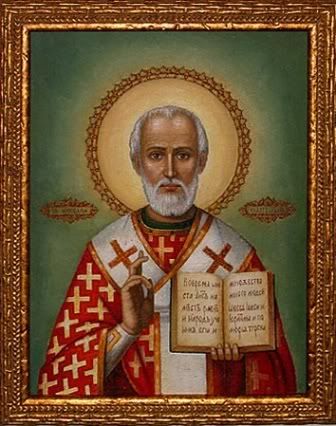
St. Nicholas of Myra: 6 December 3012


St. Nicholas (270-December 6, 346) is one of the most beloved of saints, and many tails surround him.

What is known is that Nicholas was from Lycia (in Turkey today) and made pilgrimage to Palestine and Egypt, supposedly to study with the desert fathers. Returning  some years later, he went to Myra (now Demre, Turkey) where he was quickly ordained Bishop.  He was imprisoned during the Diocletian persecution, but was released when Constantine made Christianity the official religion of the Roman Empire.  He also attended the council of Nicaea. 

Nicholas was known for his generosity.  It is said that a poor man had three daughters and that just before each came of age, he would throw a bag of gold through the window, so that she would have a dowry so as not be need to be sold into slavery.  The third time the poor man caught him in the act, and Nicholas told him not to thank Nicholas but the thank God. 

Many other fantastic tails surround Nicholas, and while they al probably are based on true stories, the form in which they come to us is more like a fairy tale. Nicholas as a result of his kind actions came to be known as a Patron of children and sailors among others. 

Many Orthodox countries, as well as the Netherlands and countries in Eastern Europe celebrate St. Nicholas day.  Nicholas is always vested as a Bishop and comes on a white horse, rewarding good children with candy (in Holland with chocolate coins) and bad children with lumps of coal.  Shoes are left out to receive these gifts.  In Dutch, St. Nicholas is Sinter Klas, and in New York with its mix of Dutch and English came to be known as Santa Claus. 
Psalm 145:8-13
Proverbs 19:17, 20-23
1 John 4:7-14
Mark 10:13-16
Collect:  El Shaddai, as you raised up Nicholas of Myra to be generous to the poor, children and sailors, bless us that we may be blessings to all who are in need, and teach us to protect the poor, children, sailors, and others whom this world has forgotten, and let your blessing be upon them as well.  This we ask in the name of Yeshua haMoshiach, who lives and governs  with you in Shekina glory everlasting.  Amen. (red)

Wednesday, December 5, 2012

St. Clement of Alexandria: 5 December 2012


http://satucket.com/lectionary/Clement_Alexandria.htm

St. Clement of Alexandria was from Athens and followed many teachers until he came to the true teacher, Jesus. Athens was a trade and culture center at the time, and it was natural that the catechetical school would develop there.  Clement was one of the early teachers, beginning teaching there in about 190.  Clements main contribution to theology is in what he taught Origen.  Also during the persecution in about 212, he flees Alexandria, and going to Cappadocia to help his former pupil Bishop Alexander during the persecution.  The events of his death are unknown, but he died between 212 and 215.


 Collect:  El Shaddai, your presbyter Clement of Alexandria came to you after much seeking and dedicated himself to teaching the faith to Christians and Pagans.  Grant in this and every place men and women who are dedicated to teaching your holy word to those who know and do not know you, and grant that we would truly teach Christians what is truly meant to walk with you.  This we ask through our Saviour, Yeshuah haMoshiach who taught his disciples the truth.  Amen.  (red)

Tuesday, December 4, 2012

St. John of Damascus: 4 December 2012


John of Damascus (676-4 December 749) came from a Christian family which served the Caliph of Damascus. His father found a Christian tutor for him, and John received a well rounded education, and served the Caliph  in a high position as well from a young age.  His name was forged to a document implicating him in an invasion of Damascus.  As a result he lost his post, and had his right hand severed. The hand was miraculously restored after a night in prayer. 

He retired to Mar Saba Monastery near Jerusalem after this. He was ordained presbyter and wrote several hymns still used in the west, and many hymns still used in the east.  He was a defender of icons in the iconoclast controversy, and his writings addressed many of the theological controversies of his time including on the Jakobites, Nestorians, the Monathelites and the Manicheans and of course the Iconoclast controversy.


Collect:  El Shadai, you raised up your presbyter, John of Damascus to defend the faith, and write hymns.  So raise up in this and every generations men and women who will defend the church against heresy and who will stand up for the faith.  This we ask in the name of Yeshua haMoshiach, who stood against the false teaching of his time, and who lives and reigns with you and Ruach haKodesh, one God in shekina glory everlasting.  Amen.  (white)


Monday, December 3, 2012

Frances Xavier, Missionary, 3 December 2012


http://www.ignatianspirituality.com/9191/novena-of-grace/


Francis Xavier (7 April 1506-3 December 1552) was a Basque born in the Kingdom of Navarre.  After his education, in Paris, he was greatly influenced by Ignatius of Loyola, and was one of the cofounders of the Society of Jesus, being one of the first seven members of the order. 

Francis was ordained in 1537 and served a short stint in a hospital and as St. Innatius’s secretary before leaving for India.  He was instated by King Johns III as papal nuncio and sent to Goa, primarily to restore the faith of the Portuguese in Goa  (which was the capitol of  Portuguese India. )  Francis spent more time with the natives of India, having built some forty churches by 1544.  He also planned to visit Indonesia.  It is said, when he had troubles witnessing to the Hindus, that he would teach the children to pray for the sick.  When the sick got well after the children’s prayers, the adults came to see what was going on.   Originally he worked with the poor, but changed this tactic later, hoping to have more influence.  He began work in Portuguese Molucca (Indonesia today) in about 1546, resulting in some ten thousand Catholics in the area by the 1560s.  He also had a habit of setting Bible verses to short catchy tunes in native languages, which helped the word to be spread.

July 1549 saw him in Japan, where at first he had trouble being admitted to any ports.  He finally was admitted and had moderate success, partly for the sake of the language, and the lack of Japanese speaking clergy.  The Japanese were able to establish indigenous churches which lasted some time, considering that they had been cut off from the main church. 

In 1552 he reached the islands of Chin.  He was seeking passage to the mainland, when he died of fever on 3 December 1552.  He should go down with William Carrey and Count Zinzendorf as one of the great missionaries, spreading the news of salvation. 

El Shadai:  You raised up Francis Xavier to proclaim the Gospel in diverse lands of Asia.  Raise up in this and every generation men and women who are ready to proclaim the Gospel to all the world, no matter what the cost.  This we ask in the name of Yeshua haMoshiach who lives and reins with you and the Rucah haKodesh, on God in Shekina glory everlasting.    Amen.


Saturday, December 1, 2012

Nicholas Ferrar: 1 December 2012


http://satucket.com/lectionary/Nicholas_Ferrar.htm

Nicholas Ferrar (1592-1637)

Many wonder when I leave out so many English Saints, why I remember the Deacon from Little Gidding. 

After being ordained to the deaconate, Nicholas and his family and some friends retired to Little Giddng, in Huntindonshire, England. Once there, they dedicated themselves to prayer, fasting and giving of alms.  They restored the church there, and were responsible to see that it had services. They also taught the children, and saw to the health of the people in the surrounding district.  They recited the daily offices and read through the entire Psaltery daily.  They always kept at least one person before the alter kneeling in prayer, so as to pray without ceasing.  They also wrote several books including several harmonies of the Gospels. 

Nicolas and his family were a fine example of how Christians can live, single and married together in community, serving the community around them.  The finest of Anglican tradition, with daily Morning and Evening prayer and caring for the need of the people.  This was a true case of the people being the church and any Christian family can follow their example..

http://satucket.com/lectionary/Nicholas_Ferrar.htm
Readings
Psalm 15
Exodus 35:1-5a, 24-29
Galatians 6:7-10
Luke 10:38-42


El Shaddai, you gave your deacon, Nicholas Ferrar the ability to form a Christian community that was truly dedicated to you both in prayer and ministry to others.  Grant that we, like the Ferrar family would worship you through prayer and fasting, but also in witnessing and taking care of the poor.  This we ask through Yeshua, who prayed, forgave sins and preached to the sinner. Amen.  (white)